Concept visualisation

Aerial robotics
for critical
infrastructure

Autonomous systems for physical intervention on critical infrastructure.

Scroll
The problem

Maintenance at height is still
done by hand.

Work at height hazard

Dangerous

Work at height and exposure to hazardous environments.

Maintenance cost

Costly

Access, specialist crews and outages drive maintenance costs.

Automation difficulty

Difficult to automate

Complex geometry makes stable contact hard to achieve.

Drones already sense, map and inspect infrastructure. The unsolved step is stable, repeatable physical interaction with the asset.

45,000+ km of high-voltage line circuit in Spain’s transmission grid, most of it on steel lattice towers.
€17 bn+ proposed investment in that grid to 2030, still going through approval. It includes 8,164 km of existing network to be uprated.

Sector context, not an estimate of the maintenance market. Sources: Red Eléctrica, transmission grid facilities 2024; MITECO, 16 September 2026.

Established capabilities
Observation

Observation

  • Visual & thermal inspection
  • LiDAR & mapping
  • Condition assessment
Our development focus
Physical intervention

Physical intervention

  • Surface treatment & coating
  • Maintenance & repair
  • Physical manipulation
Our technology

From
observation
to intervention.

Technical data
  • Maximum take-off mass7.9 kg
  • Configuration8 rotors, tilting
  • PowerTethered, continuous
  • Onboard coating capacity250 ml
  • Working heightup to 100 m (target)
  • Primary structureCarbon composite
  • Figures from the current design baseline. Subject to change through subsystem design and bench testing.
Target outcomes
  • ×4–×8 Faster intervention

    On localised corrosion repair, where the time is dominated by gaining access rather than by the work itself.

  • ÷2 Cost per intervention

    Taking rope-access rigging and the specialist crew off the critical path.

  • 0 h Exposure at height

    For the tasks the system performs. The crew works from the ground.

Modelled targets for localised repair on lattice towers, not measured results — the system has not yet flown. To be validated from component testing through to the first utility pilot.

ANAX LT80
Concept visualisation — system under development.Nose-mounted robotic end-effector not shown.

Status & roadmap

  1. Architecture defined 2026 ✓

    System-level design, requirements and safety concept closed.

  2. Subsystem designCurrent focus 2026

    Low-level design and interface definition.

  3. Component validation 2026

    Bench tests of key subsystems (contact, effector, propulsion).

  4. Integrated aerial demonstrator 2027

    Full platform in flight on a representative structure.

  5. Utility pilot 2027+

    First operational pilot with an asset owner.

Next milestone: first physical validation.
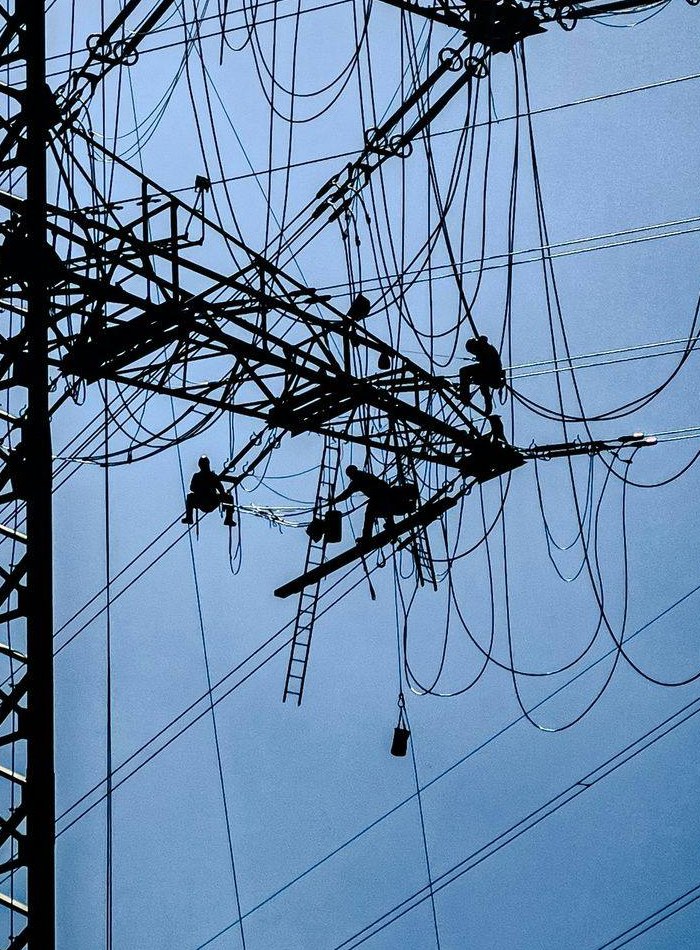
Rope-access crew working at height on a steel lattice transmission tower
Rope-access maintenance on a transmission tower.
First application

High-voltage transmission infrastructure.

Steel lattice towers need recurring corrosion protection and structural maintenance. Much of this work still depends on personnel accessing the structure directly.

Skywright is developing aerial robotics to bring the system to the structure and progressively automate physical maintenance at height.

  • Protective coating and repainting

    Protective coating & repainting

    Initial use case
  • Surface preparation and corrosion treatment

    Surface preparation & corrosion treatment

    Target capability
  • Close-range structural intervention

    Close-range structural intervention

    Platform extension
  • Contact-based inspection and testing

    Contact-based inspection & testing

    Potential capability
A platform for more

Transmission towers.
Just the beginning.

Transmission towers are the first application, not the only one.

The same platform approach applies to other large structures where access at height drives the cost of maintenance: wind turbines, industrial plants and other hard-to-reach infrastructure.

Transmission towers
First application Transmission towers
Potential applications
  • Wind turbines

    Wind turbines

    Towers and blades

  • Industrial plants

    Industrial plants

    Structures and pipework

  • Bridges and viaducts

    Bridges & viaducts

    Elevated structural elements

  • Telecom towers

    Telecom towers

    Masts and support structures

  • Port infrastructure

    Port infrastructure

    Cranes and elevated steelwork

From scope to completion

  1. 01

    Define the work

    Agree the asset, maintenance task and acceptance criteria.

  2. 02

    Deploy the service

    Skywright provides the robotic system and manages the intervention.

  3. 03

    Verify the outcome

    Document completed work against the agreed scope.

Operating model / Robotics as a service

Robotic maintenance.
Delivered as a service.

Our planned model: Skywright owns and operates the robotic system, delivering specialist maintenance within your existing workflows.

Discuss a pilot

For infrastructure owners and maintenance partners

  • No robot purchase
  • Specialist operation
  • Built around your workflow
Get in touch

Let’s talk about your infrastructure.

Exploring a use case, a pilot or a research collaboration? We would like to hear from you.

  • Grid operators
  • Maintenance companies
  • Research partners

Valencia, Spain

This form opens your own email client — nothing is sent to a server from this page. We use what you write only to reply. Privacy notice.

Or write to contact@skywright.es.